
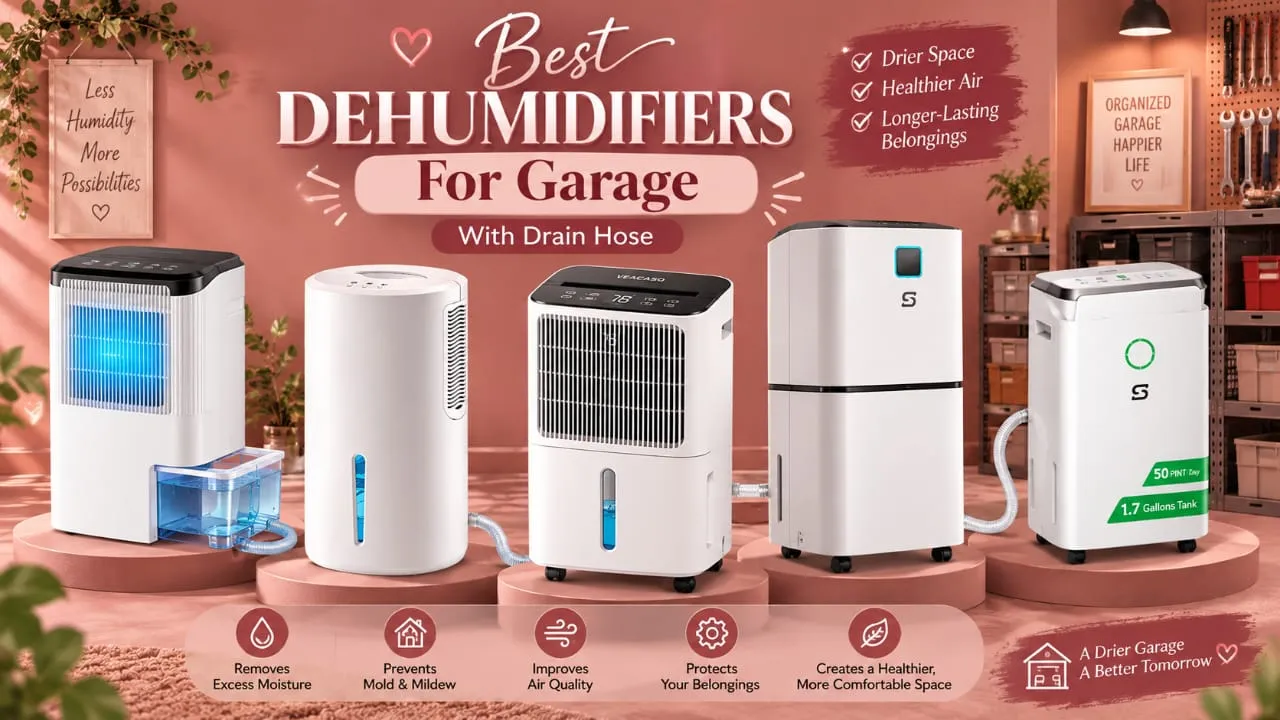
A damp garage can lead to condensation, musty odors, rust, and damage to stored items. A dehumidifier with a drain hose makes moisture control easier because you can continuously drain collected water instead of emptying the tank again and again.
Below, I’ve reviewed the 5 Amazon products you provided, including their key features, pros, cons, and the type of garage they are best suited for.
Quick Comparison
| Product | Coverage | Key Feature | Best For |
|---|---|---|---|
| Dehumidifier for Home, 2.5L Tank | Small to medium spaces | 35 dB, continuous drain hose | Quiet garage use |
| 2000 Sq. Ft. Small Dehumidifier | Up to 2,000 sq. ft. | 3.3-ft drain hose | Medium garages |
| 34 Pint/D Dehumidifier | Up to 2,500 sq. ft. | 34-pint capacity, drain hose | Large, damp garages |
| 30 Pint Dehumidifier | Up to 2,000 sq. ft. | 36 dB, 30-pint capacity | Medium to large garages |
| Small Dehumidifier | Up to 1,000 sq. ft. | Drain hose | Small garages |
1. Dehumidifier for Home, 2.5L Tank, 35dB Quiet
This 2.5L dehumidifier is a compact option for garages where humidity is moderate. Its 35 dB operation makes it a good choice if you use your garage as a workshop or hobby area and don’t want excessive noise.
The continuous drainage hose is one of its most useful features. Instead of frequently removing the tank and pouring out the collected water, you can connect the hose to a suitable drain and allow the water to flow away.
Key Features
- 2.5L water tank
- 35 dB quiet operation
- Continuous drainage hose
- Compact design
- Portable construction
- Suitable for home and garage use
Pros
- Quiet operation
- Compact and easy to move
- Continuous drainage
- Convenient for regular use
- Good for smaller garages
Cons
- Smaller capacity than 30- and 34-pint models
- May not be suitable for extremely damp garages
- More dependent on continuous drainage for extended use

Best For
Best for small to medium garages, workshops, and storage areas where quiet operation is important.
2. Dehumidifiers for Home 2000 Sq. Ft. With 3.3ft Drain Hose
This model is advertised for spaces up to 2,000 square feet and comes with a 3.3-foot drain hose. That combination makes it a practical choice for homeowners looking for convenient moisture control in a larger garage.
The drain hose can be particularly useful when the dehumidifier needs to operate for long periods. Instead of manually emptying the water tank, you can use continuous drainage when an appropriate drain is available.
Key Features
- Up to 2,000 sq. ft. advertised coverage
- 3.3-foot drain hose
- Continuous drainage
- Portable design
- Suitable for larger rooms
- Designed for home and basement use
Pros
- Good advertised coverage
- Drain hose included
- Convenient for continuous operation
- Suitable for medium and large garages
- Portable
Cons
- Hose length may not suit every garage
- Actual performance depends on humidity conditions
- May not be enough for extremely damp spaces

Best For
Best for medium-sized garages where continuous drainage is a priority.
3. 34 Pint/D, 2500 Sq. Ft. Dehumidifier for Basement With Drain Hose
For a large garage with significant humidity, this 34-pint model is one of the strongest options in your list. It is advertised for up to 2,500 square feet and offers a drain hose for continuous drainage.
The higher capacity makes it more suitable for garages with persistent moisture, condensation, damp concrete floors, or limited ventilation. A continuous drain can also make the unit more convenient for long-term operation.
Key Features
- 34-pint daily capacity
- Up to 2,500 sq. ft. advertised coverage
- Drain hose
- Continuous drainage
- Designed for basements and large areas
- Portable design
Pros
- High moisture-removal capacity
- Large advertised coverage
- Drain hose improves convenience
- Good for damp garages
- Suitable for larger areas
Cons
- Larger than compact models
- May use more energy than smaller units
- Not necessary for very small garages
- Requires proper drainage installation

Best For
Best for large garages, damp workshops, and garages with persistent humidity problems.
Read also : Best Small Dehumidifier for Bathroom
4. 2000 Sq. Ft. Dehumidifier, 30 Pint, 36 dB
This 30-pint dehumidifier offers a useful balance between capacity, coverage, and noise. It is advertised for up to 2,000 square feet and operates at approximately 36 dB.
If your garage is also used as a workshop, gym, or storage area, quieter operation can be helpful. The 30-pint capacity also makes it more suitable for higher humidity than many small portable dehumidifiers.
Key Features
- 30-pint capacity
- Up to 2,000 sq. ft. advertised coverage
- 36 dB operation
- Suitable for basements and garages
- Drainage capability
- Portable design
Pros
- Good balance of capacity and size
- Suitable for larger garages
- Relatively quiet
- More powerful than mini dehumidifiers
- Versatile home use
Cons
- May be too large for a small garage
- Not as powerful as some 34-pint models
- Requires suitable drainage setup

Best For
Best for medium to large garages where you want good moisture removal without choosing the largest model.
5. Small Dehumidifier for Bedroom Up to 1000 Sq. Ft. With Drain Hose
If you have a smaller garage with moderate humidity, this compact model may be a better choice than purchasing a large 30- or 34-pint unit.
It is advertised for spaces up to 1,000 square feet and includes drain-hose capability. Its smaller design should also make it easier to position in a garage where floor space is limited.
Key Features
- Up to 1,000 sq. ft. advertised coverage
- Drain hose
- Compact design
- Portable
- Designed for bedrooms and smaller spaces
- Continuous drainage capability
Pros
- Good for small garages
- Compact and portable
- Drain hose adds convenience
- Easy to position
- Suitable for moderate humidity
Cons
- Limited compared with larger models
- Not ideal for severely damp garages
- May need longer operation in humid conditions

Best For
Best for small garages, workshops, storage rooms, and moderate humidity.
What Type of Dehumidifier Is Best for a Garage?
A compressor-style dehumidifier with continuous drainage is generally a good choice for a garage with significant humidity. Garages can collect moisture from vehicles, concrete floors, outdoor air, and temperature changes.
For a large garage, a 30- to 34-pint model can provide more moisture-removal capacity than a small portable unit. Among these five products, the 34-pint model with 2,500 sq. ft. coverage is the strongest choice for a large and damp garage.
For a smaller garage, the 1,000 sq. ft. model may be sufficient.
What Is a Good Dehumidifier for a Garage With a Hose?
A good garage dehumidifier should have enough capacity for the size of your garage and support continuous drainage. A drain hose saves you from repeatedly emptying the collection tank.
The 34-pint, 2,500 sq. ft. dehumidifier is the best option from this list for large garages. The 30-pint, 2,000 sq. ft. model is another good option for medium and large garages.
Is It a Good Idea to Put a Dehumidifier in a Garage?
Yes, a dehumidifier can be useful if your garage regularly feels damp or has condensation.
Excess humidity can contribute to:
- Condensation
- Musty odors
- Rust on tools and equipment
- Damp cardboard
- Moisture on walls and floors
- Uncomfortable working conditions
However, a dehumidifier should not be the only solution. Check for leaks, improve ventilation when appropriate, and prevent rainwater from entering through the garage door.
What Is the Best Size Dehumidifier for a Garage?
The right size depends on your garage’s square footage and humidity level.
For a general starting point:
- Small garage: 20–30 pints per day
- Medium garage: 30–35 pints per day
- Large or very damp garage: 34+ pints per day
These are general guidelines because actual performance can vary depending on temperature, humidity, ventilation, and moisture sources.
From the products you provided, the 30-pint and 34-pint models are better suited to larger garages.
How Can I Dehumidify My Garage?
The easiest way is to use a properly sized dehumidifier with continuous drainage. You can also take several additional steps to control moisture.
First, check the garage for roof, wall, plumbing, or door leaks. Even the best dehumidifier will struggle if water is continuously entering the space.
Second, improve ventilation when outdoor humidity is appropriate. Opening the garage door when outdoor air is extremely humid may actually make the problem worse.
Third, avoid leaving wet equipment, clothing, or gardening tools inside the garage whenever possible.
Finally, use a hygrometer to monitor humidity. This allows you to see whether your dehumidifier is keeping moisture at a comfortable level.
Conclusion
Choosing the best dehumidifier for a garage with a drain hose depends mainly on your garage size and humidity level.
For a large or consistently damp garage, the 34-pint, 2,500 sq. ft. dehumidifier is the strongest option from the five products you provided. Its higher capacity and drain hose make it suitable for demanding moisture-control needs.
The 30-pint, 2,000 sq. ft. model is a good alternative for medium and large garages, while the 1,000 sq. ft. model is better suited to smaller spaces.
For the best results, combine your dehumidifier with proper drainage, leak prevention, appropriate ventilation, and humidity monitoring.
Frequently Asked Questions
Can I leave a dehumidifier running in my garage?
Many dehumidifiers are designed for extended operation, but always follow the manufacturer’s instructions. If you use continuous drainage, make sure the hose is correctly installed and the water can flow safely to the drain.
Should I use a dehumidifier in an unheated garage?
It depends on the temperature. Some compressor dehumidifiers become less effective in very cold conditions. Check the manufacturer’s minimum operating temperature before using one in an unheated garage.
How long should a dehumidifier run in a garage?
The required runtime depends on the humidity, temperature, garage size, and moisture sources. A humidity-control setting can help the unit automatically cycle when necessary.
Does a garage need a dehumidifier in summer?
It can be useful, especially in humid climates. Outdoor air entering through an open garage door can introduce additional moisture, while temperature changes can cause condensation.
Can I use a basement dehumidifier in my garage?
Yes, if the manufacturer’s operating-temperature and installation requirements are suitable for your garage. Many basement dehumidifiers are also designed for other large areas.
Is a drain hose better than an internal water tank?
For continuous operation, a drain hose is usually more convenient. It allows collected water to flow directly to a suitable drain instead of requiring you to empty the tank manually.



1 Comment
[…] Read also : Best Dehumidifier for Garage With Drain Hose […]