
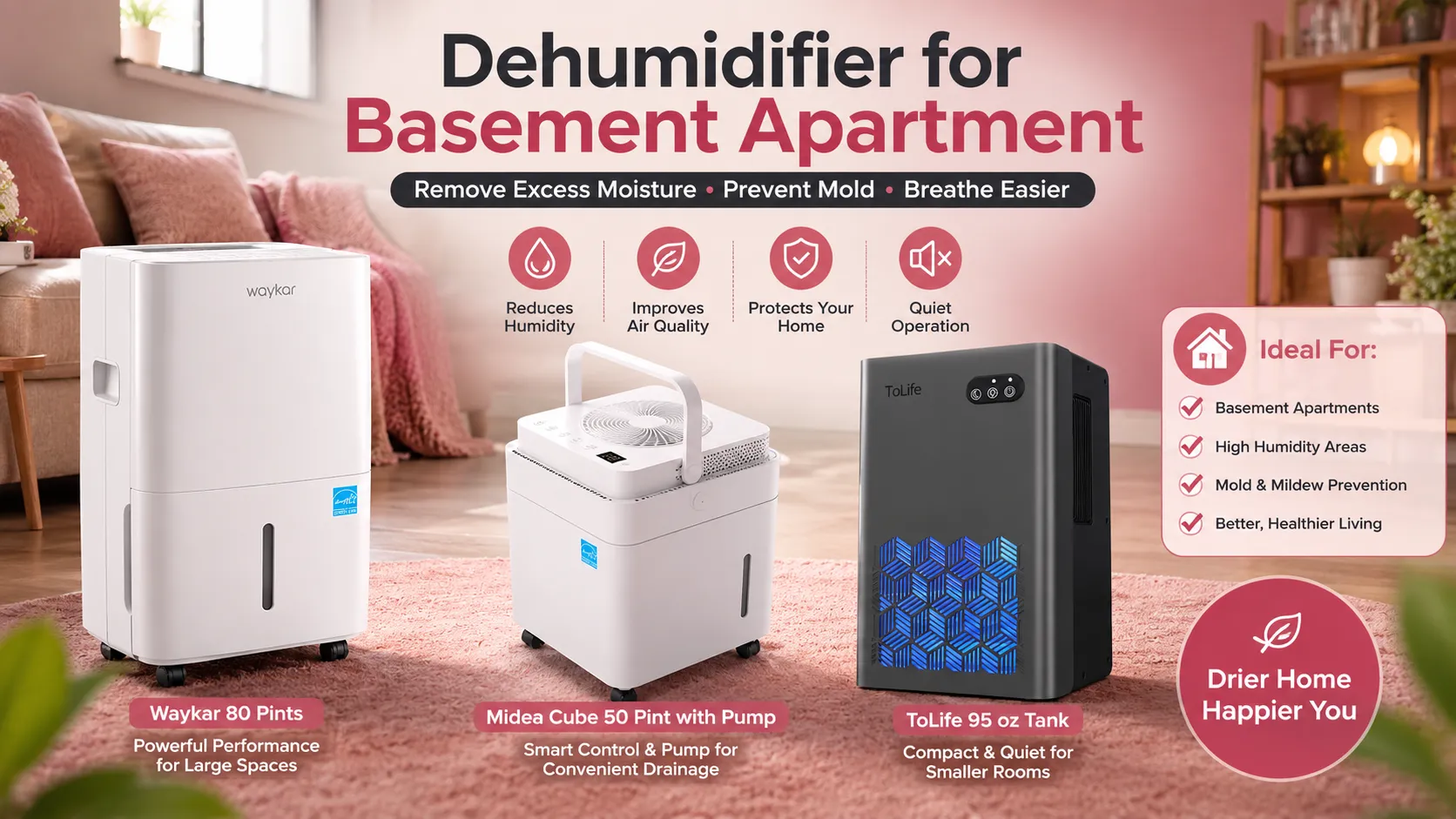
A basement apartment can often feel damp, humid, and uncomfortable, especially during rainy or humid weather. Excess moisture may also contribute to musty odors, condensation, and an unpleasant indoor environment. Choosing the right dehumidifier can help manage excess moisture and make your basement apartment feel fresher and more comfortable.
In this guide, we compare three different Amazon dehumidifiers: the Waykar 80 Pints 5000 Sq. Ft 2025 Energy Star Dehumidifier, Midea Cube 50 Pint Dehumidifier with Pump, and ToLife Dehumidifier with a 95 oz tank. Each model has different strengths, so you can choose one according to your apartment size, humidity level, and drainage requirements.
Comparison Table
| Product | Coverage | Capacity | Key Feature | Best For |
|---|---|---|---|---|
| Waykar 80 Pints | Up to 5,000 sq. ft. | 80 pints/day | Energy Star and continuous drainage | Large and very humid basements |
| Midea Cube 50 Pint | Up to 4,500 sq. ft. | 50 pints/day | Built-in pump and smart control | Convenient basement drainage |
| ToLife Dehumidifier | Up to 1,000 sq. ft. | 95 oz. tank | Sleep Mode and auto shutoff | Small basement apartments |
1. Waykar 80 Pints 5000 Sq. Ft 2025 Energy Star Dehumidifier for Basement
The Waykar 80 Pints 5000 Sq. Ft 2025 Energy Star Dehumidifier is designed for larger areas where excess moisture is a regular concern. With its advertised coverage of up to 5,000 square feet, it can be a suitable option for large basement apartments, open-plan basements, and other spacious areas.
One of the most useful features for basement applications is the continuous drainage option. Instead of repeatedly removing and emptying the water tank, users can connect a drain hose to an appropriate drainage location. This can be especially helpful when the dehumidifier needs to operate for long periods.
The unit also provides adjustable humidity control, automatic defrost, a timer, and automatic restart. These features can make everyday operation easier and allow users to customize the machine according to their indoor humidity needs.
Key Features
- Advertised coverage of up to 5,000 sq. ft.
- Up to 80 pints of moisture removal per day under specified conditions
- Energy Star certification
- Adjustable humidity control
- Removable water tank
- Continuous drainage option
- Drain hose
- Automatic defrost function
- Automatic restart
- 24-hour timer
- Washable air filter
- Touch controls
- Portable design
Pros
- High moisture-removal capacity
- Suitable for large basement apartments
- Continuous drainage can reduce maintenance
- Energy Star certified
- Automatic defrost is useful in cooler environments
- Adjustable humidity settings
- Multiple operating features
Cons
- May be too powerful for a small apartment
- Larger than compact dehumidifiers
- Water tank needs manual emptying when continuous drainage is not used
- Actual performance can vary depending on temperature and humidity conditions

Best For
Best for large basement apartments, open basement areas, and spaces with persistent humidity problems.
2. Midea Cube 50 Pint Dehumidifier with Pump, 4,500 Sq. Ft, Smart Control
The Midea Cube 50 Pint Dehumidifier with Pump is a practical option for basement apartments where drainage is an important consideration. It offers an advertised coverage area of up to 4,500 square feet and has a 50-pint capacity, making it suitable for many medium-to-large residential spaces.
The built-in pump is one of its biggest advantages. Basement apartments do not always have a convenient floor drain, so a pump can make it easier to move collected water toward an appropriate drainage point.
Another useful feature is smart control. This allows users to operate and monitor the dehumidifier more conveniently. The Cube design also provides a distinctive approach to water collection and storage while maintaining a relatively practical footprint.
Key Features
- 50-pint capacity
- Advertised coverage up to 4,500 sq. ft.
- Built-in pump
- Smart control functionality
- Continuous drainage capability
- Large water collection capacity
- Adjustable humidity settings
- Automatic shutoff
- Cube-style design
- Portable construction
Pros
- Built-in pump is useful for basement drainage
- Large advertised coverage area
- Smart control features
- Suitable for humid basement environments
- Large water collection capacity
- Convenient design
- Reduces the need for frequent manual emptying when continuous drainage is properly configured
Cons
- May be more than needed for a small apartment
- Pump drainage requires an appropriate setup
- Smart features may not be necessary for everyone
- Can be more expensive than basic compact models

Best For
Best for basement apartments where convenient drainage, larger coverage, and smart operation are important.
3. ToLife Dehumidifier, 1000 Sq Ft 95 oz Tank with Sleep Mode, Auto Shutoff
The ToLife Dehumidifier is the compact choice among these three models. It is advertised for spaces up to 1,000 square feet and features a 95-ounce water tank, making it more suitable for smaller apartments and individual rooms.
Its smaller design can be useful for basement apartments where floor space is limited. It can be positioned in areas such as a bedroom, living room, bathroom, or smaller basement section.
Sleep Mode is another useful feature for apartment living. If you prefer to run the dehumidifier during the night, this mode can make operation more suitable for sleeping areas. The automatic shutoff feature also stops the unit when the water tank becomes full.
Key Features
- Advertised coverage up to 1,000 sq. ft.
- 95-ounce water tank
- Sleep Mode
- Automatic shutoff
- Compact design
- Suitable for smaller rooms
- Easy to move
- Designed for everyday moisture control
Pros
- Compact and space-saving
- Suitable for smaller basement apartments
- Sleep Mode is useful at night
- Automatic shutoff
- Easy to move between rooms
- Suitable for targeted moisture control
- Takes up less space than large-capacity models
Cons
- Lower capacity than the Waykar and Midea models
- Smaller tank may require frequent emptying
- Not ideal for very large or extremely damp basements
- Better suited to individual rooms and smaller areas

Best For
Best for small basement apartments, bedrooms, bathrooms, and moderately humid areas.
Read also : Best Products to Remove Damp Smell From a Room: 4 Effective Odor & Moisture Solutions
Which Dehumidifier Is Best for a Basement Apartment?
The best dehumidifier depends on your apartment’s size and how severe the humidity problem is.
The Waykar 80 Pints is the strongest choice for a large basement apartment with persistent moisture. Its high capacity and advertised coverage make it suitable for larger spaces.
The Midea Cube 50 Pint is a good choice if drainage convenience is your priority. Its built-in pump can be particularly useful when there is no convenient floor drain nearby.
The ToLife Dehumidifier is better suited to smaller basement apartments and individual rooms. Its compact size and Sleep Mode make it convenient for everyday residential use.
Conclusion
Choosing the best dehumidifier for a basement apartment requires more than simply looking at the highest pint rating. You should consider the size of your apartment, the amount of moisture present, available drainage, and how often you want to empty the water tank.
The Waykar 80 Pints is a strong option for large and highly humid basement spaces. The Midea Cube 50 Pint stands out for its pump and smart-control features, making it useful when convenient drainage is important. Meanwhile, the ToLife Dehumidifier is a compact choice for smaller apartments and rooms.
Before purchasing, check the manufacturer’s current specifications and make sure the advertised coverage and drainage options match your basement’s actual requirements.
Frequently Asked Questions
1. What size dehumidifier is best for a basement apartment?
The right size depends on the square footage and humidity level of your basement apartment. Larger and very damp spaces generally require higher-capacity models, while smaller apartments may only need a compact dehumidifier.
2. Is an 80-pint dehumidifier too large for a basement apartment?
Not necessarily. An 80-pint model can be useful for a large or highly humid basement. However, a smaller model may be more practical if your apartment is small and has only moderate humidity.
3. Is the Midea Cube 50 Pint good for basement use?
Yes. Its 50-pint capacity, advertised large coverage area, pump, and smart-control features make it a suitable option for many basement environments.
4. How often should I run a dehumidifier in my basement apartment?
It depends on the humidity level. A consistently damp basement may require longer operation, while a moderately humid space may need less frequent use. Using a humidity setting can help the unit automatically manage moisture.
5. Can a dehumidifier remove a musty basement smell?
A dehumidifier can help reduce excess moisture that contributes to musty conditions. However, if the smell is caused by mold, leaks, standing water, or another moisture source, that underlying problem should also be addressed.
6. Is continuous drainage better for a basement dehumidifier?
Continuous drainage can be more convenient for long-term operation because you do not need to empty the water tank repeatedly. It is particularly useful when the basement has an appropriate drain.
7. Is the ToLife Dehumidifier good for a large basement?
The ToLife model is advertised for up to 1,000 square feet, so it is more appropriate for smaller spaces or individual rooms. A larger-capacity model may be more suitable for a large, heavily humid basement.
8. What humidity level is recommended for a basement apartment?
Generally, indoor relative humidity around 30% to 50% is considered a comfortable range. A dehumidifier with adjustable humidity controls can make it easier to maintain your preferred level.



2 Comments
[…] Read also : Best Dehumidifier for Basement Apartment(2026) […]
[…] Read also : Best Dehumidifier for Basement Apartment(2026) […]