
An attic can be one of the most difficult areas of a home to keep dry. Warm air, temperature changes, poor ventilation, roof leaks, and moisture moving upward from the living space can all contribute to excess humidity. If the moisture is persistent, it may lead to condensation, musty odors, damp insulation, and other moisture-related issues.
For small or enclosed attic areas, moisture absorbers can be a convenient solution because they do not require electricity. However, they are not a replacement for a full-size dehumidifier when an entire attic has severe or ongoing humidity problems. Passive absorbers work best in smaller, enclosed areas, while electric dehumidifiers are generally more effective for whole-room moisture control.
In this guide, we compare five Amazon-listed products, including one electric dehumidifier and four passive moisture-absorbing options. The goal is to help you choose the right product based on your attic size, moisture level, portability, and maintenance needs.
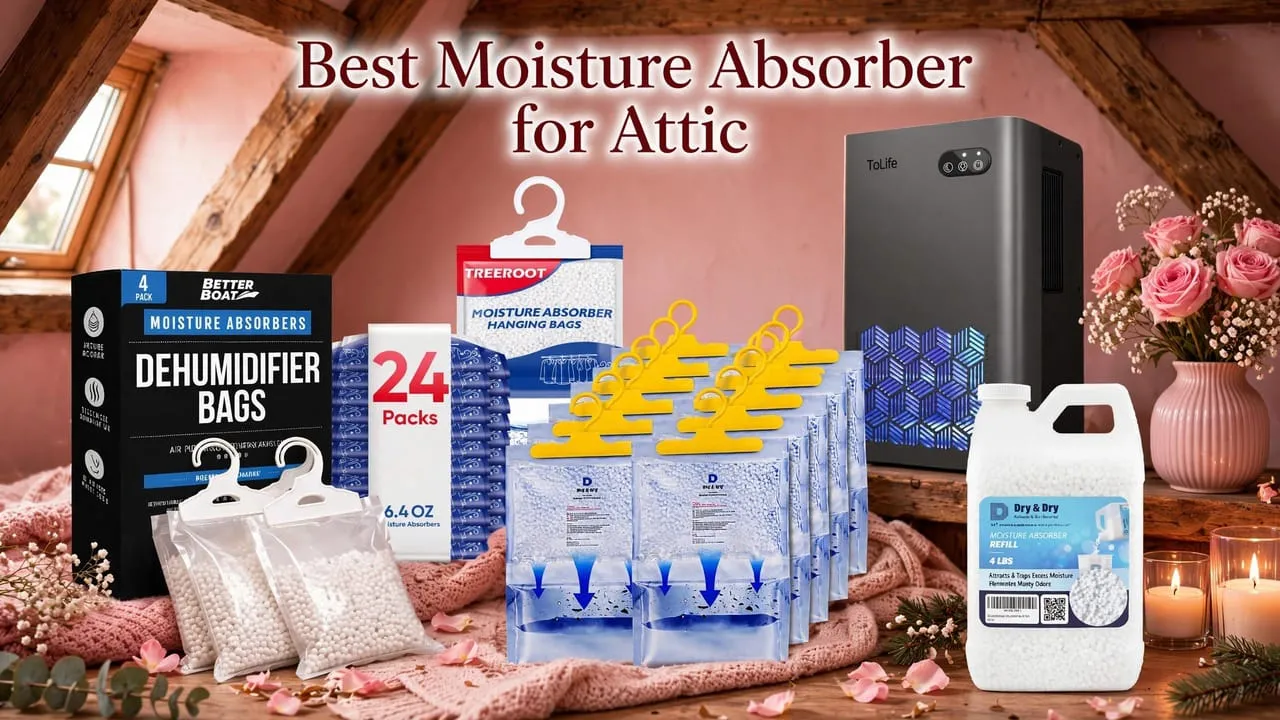
Best Moisture Absorbers for Attic Comparison
| Product | Type | Capacity/Quantity | Key Feature | Best For |
|---|---|---|---|---|
| ToLife Dehumidifier | Electric | 95 oz tank | Sleep mode & auto shutoff | Small finished attic |
| Dry & Dry Premium Moisture Absorbers | Passive | 14 oz, 12-pack | Multiple absorbers | Attic corners & storage |
| 24 Moisture Absorbers | Passive | 6.4 oz bags | Compact humidity absorbers | Small enclosed areas |
| 4 Pack Hanging Moisture Absorbers | Passive | 4 bags | Hanging design & charcoal | Attic closets & enclosed spaces |
| Dry & Dry Refill Beads | Passive refill | 4 lbs | Reusable absorber system | Long-term moisture control |
1. ToLife Dehumidifier, 1000 Sq. Ft. 95 oz Tank
The ToLife Dehumidifier is the only electric dehumidifier in this particular lineup. It features a 95-ounce water tank and is designed for spaces up to 1,000 square feet.
For a finished attic with access to electricity, an electric unit can be more practical than passive moisture absorbers when humidity affects a larger area. Electric dehumidifiers actively circulate air and extract moisture, while passive absorbers work more slowly and are better suited to enclosed spaces.
The ToLife model also includes sleep mode and automatic shutoff, making it convenient for homeowners who want an appliance that can operate without constant supervision.
Key Features
- 95 oz water tank
- Rated for spaces up to 1,000 sq. ft.
- Sleep mode
- Automatic shutoff
- Electric operation
- Compact design
- Designed for indoor use
Pros
- Larger capacity than many mini units
- Active moisture removal
- Sleep mode can make nighttime operation more convenient
- Automatic shutoff
- Suitable for finished attic spaces with electricity
Cons
- Requires an electrical outlet
- Needs regular water-tank emptying unless drainage is available
- May not be suitable for extremely hot or cold unfinished attics
- Larger than passive moisture absorbers

Best For
Best for a finished or accessible attic where electricity is available and active moisture removal is needed.
2. Dry & Dry Premium Moisture Absorbers, 14 oz, Pack of 12
The Dry & Dry Premium Moisture Absorbers come in a 12-pack of 14-ounce units, making them useful when you need multiple moisture absorbers around an attic.
Instead of using electricity, passive moisture absorbers attract moisture from the surrounding air. This makes them convenient for areas where installing or operating an electric dehumidifier isn’t practical.
A multipack can also be useful because you can distribute individual absorbers around different attic storage areas, closets, corners, or enclosed spaces.
Key Features
- 14 oz each
- Pack of 12
- Passive moisture absorption
- Designed for home use
- Suitable for bedrooms, basements, and small spaces
- No electricity required
Pros
- No electricity needed
- Easy to distribute around an attic
- Convenient 12-pack
- Compact compared with electric dehumidifiers
- Useful for enclosed areas
Cons
- Slower than an electric dehumidifier
- Requires replacement or maintenance
- Not ideal for an entire large attic
- Collected moisture needs appropriate handling

Best For
Best for attic corners, storage areas, and smaller enclosed spaces where electricity isn’t available.
3. 24 Moisture Absorbers for Closet, 6.4 oz Humidity Absorber Bags
These 6.4-ounce moisture absorber bags are another passive option for managing localized humidity.
Their compact design makes them easy to position in areas where a traditional dehumidifier would be inconvenient. They can be particularly useful around attic storage, closets, small compartments, and other enclosed areas.
Because they are passive absorbers, however, they should be viewed as a targeted moisture-control solution rather than a substitute for an electric dehumidifier in a large attic with persistent humidity.
Key Features
- 6.4 oz moisture absorber bags
- 24-pack
- Compact design
- No electricity required
- Suitable for closets and enclosed spaces
- Portable
Pros
- Large quantity
- Easy to place in multiple areas
- No electricity required
- Compact and portable
- Convenient for attic storage spaces
Cons
- Limited capacity per bag
- Not designed for whole-attic moisture removal
- Requires replacement
- Can be less effective in large open spaces

Best For
Best for small attic storage areas, closets, corners, and enclosed spaces.
Read Also : Best Dehumidifier for Laundry Room(2026)
4. 4 Pack Moisture Absorber Hanging Bags with Charcoal
The 4 Pack Moisture Absorber Hanging Bags provides a convenient hanging design. Instead of taking up floor or shelf space, the bags can be positioned in suitable areas where moisture and odors are a concern.
The inclusion of charcoal makes this option particularly interesting for areas where musty smells are also an issue. Moisture absorbers and odor-control products can serve different purposes, so it’s important to understand that odor reduction does not necessarily mean the same thing as removing large amounts of moisture.
Key Features
- Four-pack
- Hanging bag design
- Moisture absorption
- Charcoal included
- No electricity required
- Suitable for enclosed spaces
Pros
- Easy hanging design
- Doesn’t require an outlet
- Saves floor space
- Useful in storage areas
- Charcoal can help with odors
Cons
- Limited moisture capacity
- Not suitable for severe attic humidity
- Requires replacement
- Better for targeted areas than large open spaces

Best For
Best for attic closets, storage areas, and enclosed spaces where both moisture and musty odors are concerns.
5. Dry & Dry Moisture Absorbers Refill Beads, 4 LBS
The Dry & Dry Moisture Absorbers Refill Beads provide a different approach because the 4-pound package is designed as a refill material rather than a conventional single-use bag.
This can be useful if you already have a compatible moisture absorber container and want to replenish the absorbing material instead of purchasing a completely new absorber.
The refill format can also make sense for homeowners who regularly manage moisture in storage areas, closets, and other small spaces.
Key Features
- 4 lbs of refill beads
- Designed for moisture absorption
- Suitable for home use
- Refill format
- Useful for basements, bedrooms, and storage areas
- No electricity required
Pros
- Large quantity
- Convenient refill format
- Can reduce the need to purchase complete units
- No electricity required
- Useful for ongoing moisture control in smaller areas
Cons
- Requires a compatible container
- Not suitable for whole-attic humidity control
- Requires monitoring and replacement
- Not as powerful as an electric dehumidifier

Best For
Best for homeowners who already use a compatible moisture absorber and want a bulk refill option.
Which Is the Best Moisture Absorber for an Attic?
The best option depends on how large your attic is and how severe the moisture problem has become.
For a finished attic with electricity, the ToLife 95 oz Dehumidifier provides active moisture removal and is the most appropriate option in this lineup for treating a larger area.
For small enclosed attic spaces, the Dry & Dry 14-ounce absorbers offer the convenience of a 12-pack, allowing you to place several units around the attic.
The 24-pack of 6.4-ounce bags is useful when you need multiple compact absorbers, while the 4-pack hanging bags are convenient when floor and shelf space are limited.
The Dry & Dry 4-pound refill beads are best suited to people who already have a compatible moisture-absorbing container and want a bulk refill solution.
Moisture Absorbers vs. Electric Dehumidifiers
It is important to understand the difference before buying.
An electric dehumidifier actively circulates air and removes moisture continuously while it is running. Passive moisture absorbers don’t use fans or compressors; they rely on moisture-attracting materials and are generally better suited to small, enclosed areas.
Independent testing has also found that passive moisture absorbers can help with low-level dampness but work much more slowly than electric dehumidifiers. For persistent or severe humidity, an electric dehumidifier is generally the more effective option.
How to Choose the Right Attic Moisture Control
Consider the Attic Size
Before buying anything, determine whether you are trying to control humidity throughout the entire attic or simply protect a small storage area.
A small absorber may be perfectly reasonable for an enclosed storage section but insufficient for a large attic.
Check for Electricity
If your attic has a convenient electrical outlet, an electric dehumidifier gives you active moisture removal. If there is no convenient power source, passive absorbers may be easier to use.
Look for the Actual Moisture Source
High attic humidity isn’t always simply a dehumidifier problem. Roof leaks, plumbing leaks, poor ventilation, and warm moist air entering the attic can all contribute to moisture problems.
If moisture is entering because of a leak or ventilation issue, simply adding an absorber may only address the symptom.
Use a Hygrometer
A hygrometer can help you monitor relative humidity instead of guessing whether the attic is too damp. This is especially useful when deciding whether a small absorber is enough or whether you need a powered dehumidifier.
Conclusion
Choosing the best moisture control solution for an attic depends on the size of the space and the severity of the humidity problem.
The ToLife 95 oz Dehumidifier is the strongest choice from these five products when you need active electric moisture removal in a suitable finished attic. For smaller or enclosed attic areas, the Dry & Dry Premium Moisture Absorbers offer a convenient 12-pack, while the 24-pack of 6.4-ounce bags provides plenty of compact absorbers for multiple locations.
The hanging moisture absorber bags are useful when you want to save floor space and address musty odors, while the Dry & Dry 4-pound refill beads are a practical choice for compatible reusable absorber systems.
Most importantly, don’t rely on a moisture absorber to hide a serious attic moisture problem. Persistent humidity can be caused by leaks, poor ventilation, or air leakage from the living space. Addressing the underlying source should come first, with dehumidification or passive moisture absorption used as part of the overall moisture-control strategy.
Frequently Asked Questions
What is the best way to remove moisture from an attic?
The best approach depends on the cause and severity of the moisture. First identify and fix leaks or sources of moisture. Proper attic ventilation and air sealing are also important. For persistent humidity in a finished or suitable attic, an appropriately sized electric dehumidifier can actively remove moisture. Passive absorbers are better suited to small, enclosed areas.
What absorbs moisture and smells?
Moisture absorbers can help reduce humidity, while materials such as activated charcoal are commonly used for odor control. Products that combine moisture absorption with charcoal can therefore be useful for small enclosed areas where both dampness and musty smells are concerns.
However, removing the source of the odor and excess moisture is more important than simply masking the smell.
What can I put under my house to absorb moisture?
For crawl spaces or areas beneath a house, passive moisture absorbers may help with small, localized moisture problems, but they are generally not a solution for significant or persistent crawl-space humidity. A properly sized crawl-space dehumidifier, drainage improvements, ventilation, and moisture barriers may be more appropriate depending on the cause.
Do moisture absorbers really work?
Yes, moisture absorbers can work, particularly in small enclosed spaces and for low-level dampness. However, they work more slowly and remove substantially less moisture than an electric dehumidifier. Independent testing found passive absorbers useful for mild dampness but much less effective than powered dehumidifiers for serious moisture problems.
How do I dehumidify my attic?
Start by finding the source of the moisture. Check for roof or plumbing leaks, condensation, inadequate ventilation, and air leaks from the living area below. Once the source is addressed, use an appropriately sized electric dehumidifier if the attic has persistent humidity and suitable conditions for operating one. For small enclosed spaces, passive moisture absorbers can provide supplemental moisture control.
Does having AC on reduce humidity?
Yes, a properly operating air-conditioning system can remove some moisture from indoor air as it cools the air. However, running AC does not necessarily solve a significant attic moisture problem, particularly if the attic is outside the conditioned living space. Attic ventilation, air sealing, insulation, and fixing moisture sources may still be necessary.
Can moisture absorbers replace an attic dehumidifier?
Usually not for a large attic with persistent humidity. Passive absorbers are better suited to small enclosed spaces, storage areas, and localized moisture problems. A powered dehumidifier is generally more effective when you need active moisture removal across a larger area.
Where should I place moisture absorbers in an attic?
Place them in appropriate enclosed or localized areas where moisture tends to accumulate, such as storage spaces, closets, or areas under the eaves. Keep them stable and protected from accidental tipping. Follow the product’s instructions regarding placement and disposal.



1 Comment
[…] Read also : Best Moisture Absorbers for Attic: 5 Options for Humidity Control […]